reference number : J2108
release date : 30/10/2026
release date : 30/10/2026
Photos : Anneli Ivaste
about this album
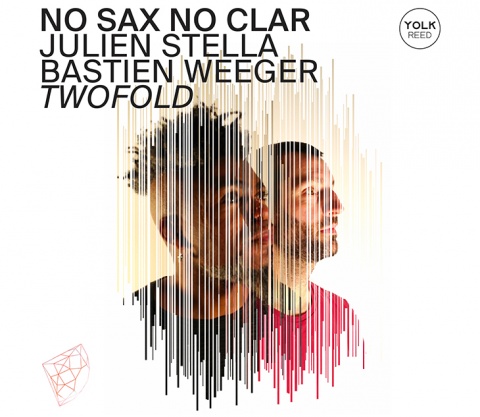
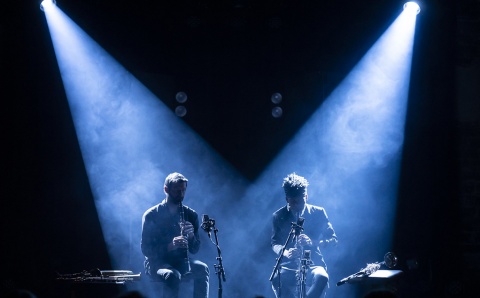
Following the albums Kahmsïn (2020), Red Sisters (2021), and No Dahïs (2023), the duo NoSax NoClar releases its fourth album, Twofold, and continues to scale the heights of improvised dialogue, offering an extraordinary glimpse into the essence of interplay in jazz. In this duo, Julien Stella’s clarinets—with their refined and velvety tone—provide a formidable framework for the virtuosic developments and soaring passages of Bastien Weeger’s saxophones (soprano and alto).
Of course, Twofold features what has defined the group since its inception: the influence of non-Western musics—Sub-Saharan, Mediterranean, Balkan, and more—in the composition of the themes, as well as that of bebop’s grammar and the great jazz tradition. Between ostinatos and counterpoints, shifting from a line played in unison to the tumult of collective improvisation, our two protagonists build a musical world far vaster than one might expect from a wind instrument duo, with compositions that reveal a deep, earthy rhythmic foundation—sometimes evoking a trance-like state—and an infinite palette of harmonic colors.
While NoSax NoClar’s music is a true invitation to wander, the duo has literally crisscrossed the globe since its inception, touring in Australia, Brazil, Canada, and throughout Europe: in fact, much of this new repertoire was composed in the high latitudes of Finland during a creative residency in the summer of 2025.
The album, which opens with a delightful and spellbinding “Valse Rouge” in 5/4 time, plunges us with “Numero Quattro” into an elliptical contrapuntal style before gently settling back with the lightness of the ostinatos in “Mazurka.” The composition “Rindaman,” meanwhile, evokes both Dave Holland’s album Conference of the Birds and Nik Bärtsch’s minimalism, while the track “Balafon”—which hints at a bebop-inspired language—displays a distinctly more Afro-funk style. The title track, “Twofold” is a veritable trance-inducing spiral built on elusive melodic-rhythmic cells; this gives way to a fascinating interlude, sung by Julien Stella, titled “Am Iridaï,” in which the clarinetist plays his instrument without a mouthpiece, imitating the timbre of a Mandinka flute. Finally, the composition of “Woods” plunges us back into the ostinato-driven interplay so dear to NoSax NoClar, while “Iridaï,” which closes the album, serves as a testament to a stylistic signature that traces more than six years of music-making as a duo.
Of course, Twofold features what has defined the group since its inception: the influence of non-Western musics—Sub-Saharan, Mediterranean, Balkan, and more—in the composition of the themes, as well as that of bebop’s grammar and the great jazz tradition. Between ostinatos and counterpoints, shifting from a line played in unison to the tumult of collective improvisation, our two protagonists build a musical world far vaster than one might expect from a wind instrument duo, with compositions that reveal a deep, earthy rhythmic foundation—sometimes evoking a trance-like state—and an infinite palette of harmonic colors.
While NoSax NoClar’s music is a true invitation to wander, the duo has literally crisscrossed the globe since its inception, touring in Australia, Brazil, Canada, and throughout Europe: in fact, much of this new repertoire was composed in the high latitudes of Finland during a creative residency in the summer of 2025.
The album, which opens with a delightful and spellbinding “Valse Rouge” in 5/4 time, plunges us with “Numero Quattro” into an elliptical contrapuntal style before gently settling back with the lightness of the ostinatos in “Mazurka.” The composition “Rindaman,” meanwhile, evokes both Dave Holland’s album Conference of the Birds and Nik Bärtsch’s minimalism, while the track “Balafon”—which hints at a bebop-inspired language—displays a distinctly more Afro-funk style. The title track, “Twofold” is a veritable trance-inducing spiral built on elusive melodic-rhythmic cells; this gives way to a fascinating interlude, sung by Julien Stella, titled “Am Iridaï,” in which the clarinetist plays his instrument without a mouthpiece, imitating the timbre of a Mandinka flute. Finally, the composition of “Woods” plunges us back into the ostinato-driven interplay so dear to NoSax NoClar, while “Iridaï,” which closes the album, serves as a testament to a stylistic signature that traces more than six years of music-making as a duo.
concerts
tracklist
01 — Valse Rouge — 04:27
02 — Numero Quattro intro — 01:41
03 — Numero Quattro — 03:37
04 —Mazurka — 05:10
05 —Rindaman — 02:44
06 —Balafon intro — 01:53
07 —Balafon — 04:14
08 — Twofold — 03:56
09 — Am Iridaï — 02:01
10 ーWoods ー 03:32
11 ーIridal ー 02:22
Compositions :
1, 4, 6, 7, 10 by Bastien Weeger
2, 3, 5, 8, 9, 11 by Julien Stella
Recorded & mixed by Pierre Dine
Mastering by Jonathan Marcoz
02 — Numero Quattro intro — 01:41
03 — Numero Quattro — 03:37
04 —Mazurka — 05:10
05 —Rindaman — 02:44
06 —Balafon intro — 01:53
07 —Balafon — 04:14
08 — Twofold — 03:56
09 — Am Iridaï — 02:01
10 ーWoods ー 03:32
11 ーIridal ー 02:22
Compositions :
1, 4, 6, 7, 10 by Bastien Weeger
2, 3, 5, 8, 9, 11 by Julien Stella
Recorded & mixed by Pierre Dine
Mastering by Jonathan Marcoz
Connexions
other works with Julien Stella
NoSax NoClar >> KAHMSÏNNoSax NoClar >> Rëd Sisters
Pigments & The Clarinet Choir >> Léon-Gontran Damas’s Jazz Poetry.
NoSax NoClar >> No Dåhïss
Guillaume Hazebrouck 6tet feat James Noël >> En toute pyromanie
other works with Bastien Weeger
NoSax NoClar >> KAHMSÏNNoSax NoClar >> Rëd Sisters
NoSax NoClar >> No Dåhïss

Photos : Anneli Ivaste